Skill chaining
If you look back at this lesson, you'll notice you didn't use just one skill. You used the dagster-expert skill to scaffold and build the dbt project and Dagster Component, and the dbt skill activated automatically for more detailed work with the actual dbt project.
This is skill chaining: switching skills as the nature of your task shifts. Each skill has a different knowledge domain. Using the right one at the right time is what keeps the agent's output trustworthy.
How to think about it
Use /dagster-expert when you're working with Dagster itself:
- Creating or scaffolding assets, schedules, sensors, jobs
- Understanding project structure and definitions
- Running or materializing assets (
dg launch,dg list) - Debugging failed runs
- Automation: conditions, partitions, backfills
- Any general Dagster concept, including asset checks and resources
The dbt skill activates automatically when you're doing dbt-specific work:
- Writing or modifying dbt models
- Creating or updating
schema.ymlwith tests and documentation - Using
ref()andsource()correctly - Running
dbt parse,dbt compile, ordbt test - Configuring
dbt_project.ymland profiles
Rule of thumb: if the task is about dbt (models, schema, dbt commands), describe the task and the dbt skill will load. If it's about Dagster (structure, definitions, dg workflow, debugging), use /dagster-expert.
The chaining pattern
Look at the switches that happened as we built this lesson:
/dagster-expertscaffolded the dbt project, created the staging models, and validated withdbt parse. This is a case where the Dagster skill is enough: creating theDbtProjectComponent, scaffolding the project layout, and wiring it into Dagster are all Dagster questions. The dbt skill adds value when you're writing or modifying dbt models directly — that comes later in the chaining sequence./dagster-experthandled wiring the dbt assets to the raw assets, setting group names, and validating withdg check defs. Once the dbt project existed as a Dagster entity, questions like "which group should these assets be in?" or "how do I make the raw assets upstream of the dbt models?" are core Dagster questions.The dbt skill activated automatically to add schema tests to the staging models. Writing
not_nullanduniquetests inschema.ymlis dbt work, not Dagster work./dagster-experthandled debugging when a materialization failed. Reading the run logs, tracing the error to a resource misconfiguration, and fixing it is Dagster debugging.
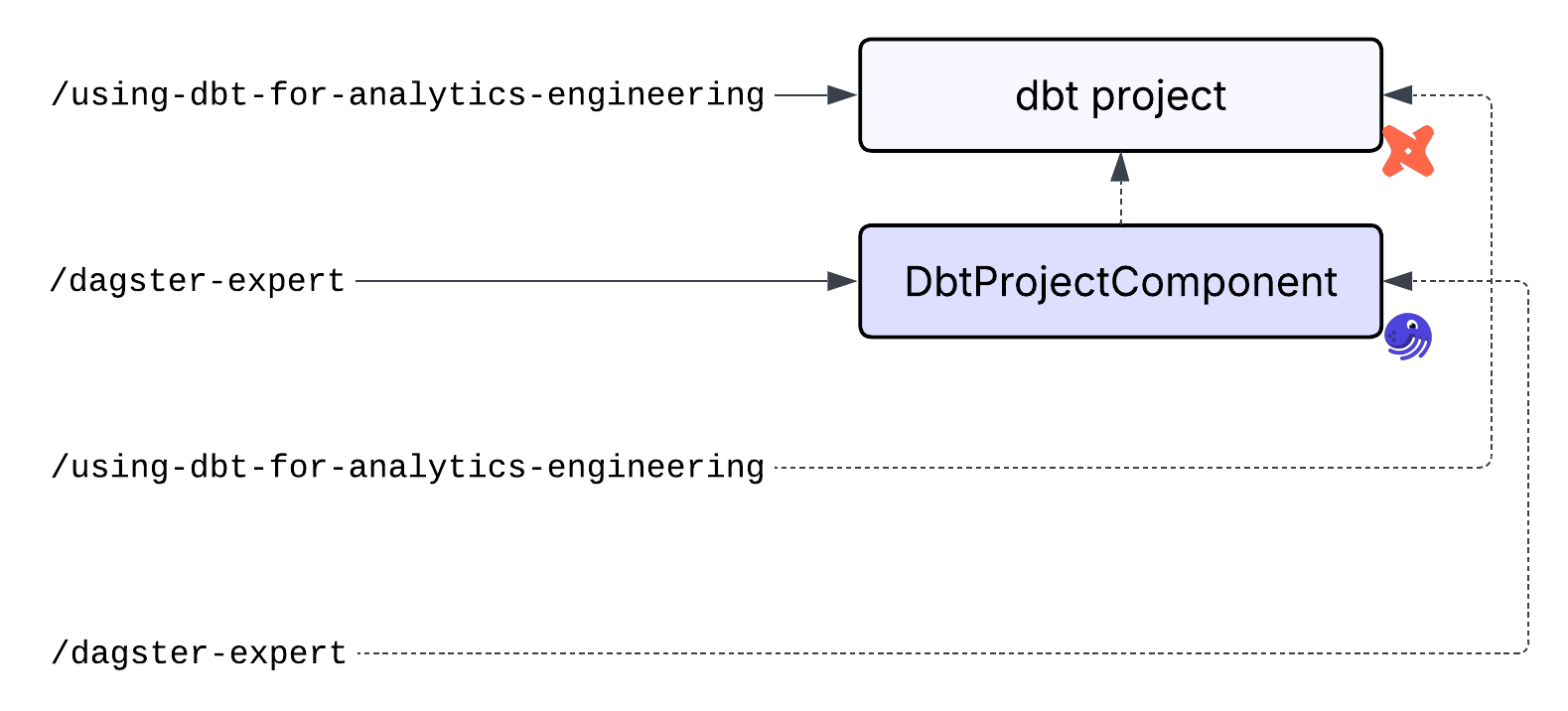
Each switch happens at a natural seam: when the task shifts from "build this dbt project" to "wire this into Dagster" and back again.
The natural seam
The seam between the two skills usually corresponds to a real boundary in the work. dbt models are SQL files with dbt-specific conventions. Dagster assets are Python definitions. The DbtProjectComponent is the bridge between them, and setting it up touches both sides.
Skill chaining isn't overhead. Each skill has deep context about its domain, and shallow context about the other's. When you're writing dbt models, the dbt skill knows far more about dbt conventions than the expert skill does. When you're debugging a failed Dagster run, the expert skill knows far more about Dagster's execution model.
Invocation cadence
Use /dagster-expert once at the start of a Dagster-focused task or when you shift back to Dagster work. You don't need to prefix every subsequent message — the agent carries the context forward through the session. Repeatedly invoking the same skill doesn't improve output; the first invocation is what primes the behavior.
The dbt skill doesn't need explicit invocation at all. Write a dbt-focused prompt and it loads. Write a Dagster-focused prompt and use /dagster-expert. That's the full pattern.
Explicit vs. implicit invocation
The two skills have different invocation models. The dagster-expert skill supports explicit invocation with /dagster-expert, which is what the course examples show -- it makes the skill boundary visible and ensures the right context is loaded. The dbt skill is trigger-based only: it loads automatically when the prompt is clearly about dbt work (model SQL, schema.yml, dbt commands). You cannot invoke it with a slash command; write a dbt-focused prompt and it activates on its own.