CLI vs MCPs
Like many others, we experimented with an MCP (Model Context Protocol) server when it looked like MCP might become the primary interface for AI assistants. MCPs can serve a purpose (exposing tools and context to the model in a structured way), but we've found that CLIs often work better than MCPs for the kind of workflows we care about.
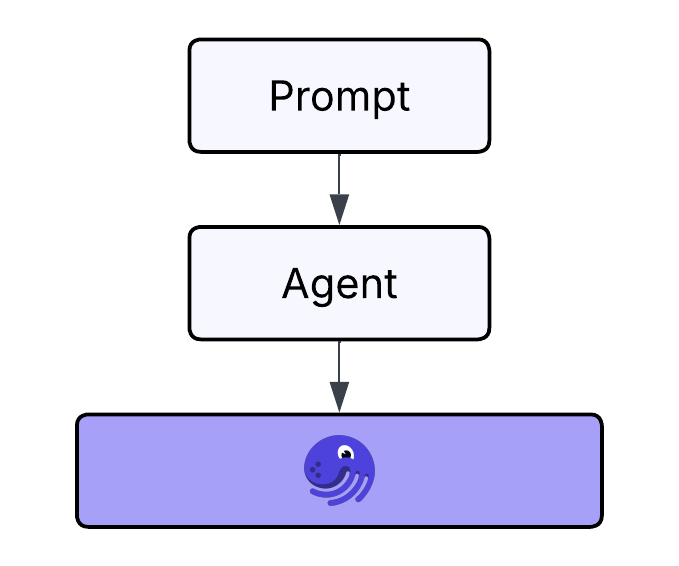
Why we favor a quality CLI
CLIs give you high quality with less surface area. LLMs tend to go off the rails when they're given too much context or too many overlapping tools. A well-designed CLI:
- Narrows the action space: the agent chooses from a small set of commands (
dg scaffold,dg check,dg list,dg launch) instead of reasoning over arbitrary file edits and API calls. - Encodes best practices: scaffolding and validation are implemented once in the CLI, so the agent doesn't have to "know" our project layout or validation rules from long docs.
- Is easy to validate: exit codes and stdout are simple to parse and assert on, in both human and automated evaluation.
- Reduces context and token usage: a CLI doesn't require the model to load large schemas, API docs, or tool descriptions. The agent gets a compact set of commands and short help; responses are typically small (exit code + stdout). That means less context in the prompt and far fewer tokens per interaction than a broad MCP tool set with rich payloads and documentation.
You'll see this pattern directly later. The skill-less agent has to reason over open-ended questions (which layout, which package manager, whether to validate), drawing on broad context. The skill-driven agent calls dg scaffold and validates with dg check defs, before attempting to execute code.
Each command returns a small, structured response. That's the CLI efficiency in practice: not a theoretical claim but a visible pattern in the agent's behavior.
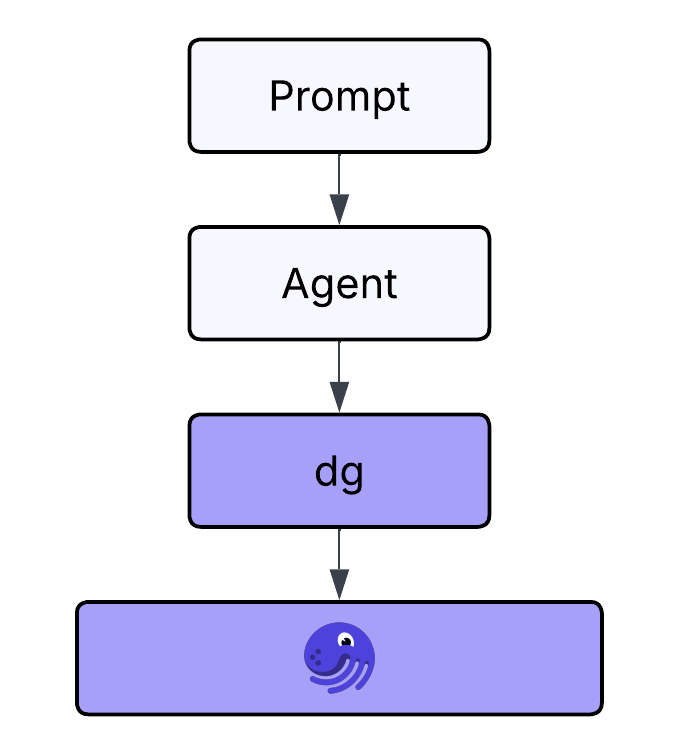
So we invest in making dg a solid, opinionated CLI and have our skills teach the agent when and how to use it, rather than relying on a large MCP surface that could overload the model.
When MCPs still help
MCPs can still be useful for things like exposing a running Dagster instance's state or serving dynamic context. For the core loop of "scaffold → edit → check → list → launch," we've found that a good CLI + skills that reference it keeps behavior more reliable and easier to evaluate than a big MCP tool set.
In short: we use a quality CLI as the main interface for agents working with Dagster projects, and use skills to guide the agent to that CLI instead of to a broad, high-context MCP surface.